




By Chris Martin, Senior Director, HealthLink Dimensions
AI, data, and technology are transforming healthcare marketing. But the most important connection we make is still the one between healthcare professionals and the patients who depend on them.
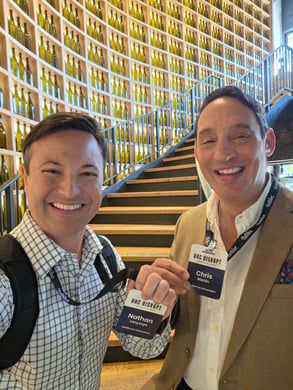
One of the things I enjoy most about attending industry events is reconnecting with colleagues I've worked alongside over the years, catching up with old friends, and meeting new people who are bringing fresh perspectives to healthcare marketing. DHC Disrupt 2026 certainly delivered on that front. Mark Bard and the DHC Group brought together an impressive cross-section of pharmaceutical marketers, agency leaders, technology companies, clinicians, and patient advocates for a day of conversations about the forces reshaping our industry.
There was plenty to discuss – including the usual suspects: artificial intelligence, advanced data strategies, privacy-first targeting, omnichannel engagement, and the increasingly complicated business of measuring marketing effectiveness. All important subjects. All deserving of our attention. But what stayed with me most wasn't a particular technology, platform, or emerging marketing capability. It was a reminder of something that can get lost amid our pursuit of innovation, stronger partnerships, and revenue growth: Ultimately, our responsibility as healthcare marketers is to help healthcare professionals deliver better care to their patients.
That responsibility may sound obvious. But how often do we truly put it at the center of our strategies? And I have to say hats off to Mark and the DHC team for weaving this into Disrupt so effectively.
Sometimes It Takes a Patient to Remind Us Why We're Here
Perhaps the most compelling reminder came from John Duffield, founder of Signal Two and author of The Future Patient, during his presentation, TheFuturePatient: Why Your Funnel Can't See Them. John's story was extraordinary. After undergoing two open-heart surgeries just 20 days apart and enduring an 18-month battle with a staph infection, he found himself navigating the healthcare system from a very different perspective than most of us experience professionally.
He described turning to AI to help make sense of his medical situation, preparing nearly 150 questions for his physicians using a personalized AI resource informed by his own medical records. He even used the technology to help explain his condition to his children through familiar references, including Taylor Swift lyrics and basketball. Think about that for a moment. Here was someone facing extraordinarily difficult medical circumstances, using technology not to replace his physicians, but to become a more informed and engaged participant in his own care.
For those of us who spend our days discussing targeting, engagement, conversion, and attribution, John's experience provides a powerful reality check. Behind every audience segment is a person. Behind every diagnosis is a patient and often a family trying to make sense of an overwhelming amount of information. And behind every healthcare professional we're trying to reach is someone responsible for helping those patients navigate incredibly important decisions. Technology becomes truly valuable when it strengthens that relationship.
When Healthcare Gets Personal
That same theme came through in Democratizing Prediction: When Knowing Changes What Comes Next, a discussion featuring Allison Ceraso, Chief Creative Officer at Digitas Health; Dr. Scott Richard, a gynecologic oncology specialist at Summit Health; Stefanie Taylor of the National Ovarian Cancer Coalition; and ovarian cancer survivor and advocate Katie Ventisette. The panel explored how advances in genetics, diagnostics, and our understanding of disease are changing what's possible in women's cancer care. Katie's experience navigating an ovarian cancer diagnosis at just 22 years old brought the discussion out of the theoretical and into the deeply personal.
Together, the perspectives of a clinician, a patient advocate, a survivor, and an agency creative leader illustrated something our industry should never overlook. Medical innovation is critically important. So is making that innovation understandable, accessible, and actionable. For those of us involved in HCP marketing, there's a direct connection. It isn't enough to reach the right physician. We need to make sure the information we deliver is relevant, credible, clinically meaningful, and useful in helping that physician make informed decisions.
The objective shouldn't simply be engagement. It should be actual and meaningful connection and engagement that matters.
AI Is Changing Healthcare. But Trust Still Matters More.
Another discussion that reinforced this theme was HCP AI Use and Trust Gap — an Oncology Deep Dive. The panel brought together Eric Trepanier, Chief HCP Officer at Publicis Health Media; Dr. Katia Dodelzon, Chief of Breast Imaging at Weill Cornell Medicine; Lisette Kimbere, an oncology nurse practitioner at Mount Sinai Hospital; and Matt Holland, Chief Operating Officer at Healio.
As AI becomes increasingly embedded in clinical workflows, the distinction between accessing information and trusting it enough to inform medical decisions becomes critically important. For healthcare marketers, that distinction should influence everything from content development and channel selection to targeting and measurement. We often talk about reaching HCPs at precisely the right moment. But reaching a physician in the middle of a complex clinical workflow is only valuable when what we're delivering helps rather than distracts.
The real opportunity for AI isn't simply more efficient advertising or greater message volume. It's helping reduce friction, improve access to trustworthy information, and give clinicians better resources to focus on their patients. And that requires understanding the needs and concerns of the people using these technologies, not simply the capabilities of the technologies themselves.
Better Data, Better Connections, Better Outcomes
Of course, delivering meaningful engagement requires the right infrastructure, and several discussions highlighted how that infrastructure is evolving. In Meeting the Moment: How AI & Data Are Delivering on Pharma Marketing's Oldest Promise, Elizabeth Beringer, President of Real Chemistry Media; Tiffany Ku, Executive Director at WPP Media; Emily Martin, Associate Director of HCP Marketing, Digital at Argenx; and Casey Carden, VP of Sales at PulsePoint, explored how improvements in data and AI are enabling more precise and timely engagement.
We've all heard the industry's familiar promise about delivering the right message to the right person at the right time. The technology is getting better at making that possible. But I would add something to that familiar promise: For the right reason. A well-timed message to a physician should accomplish more than generating an impression or engagement. Ideally, it should provide information that helps support an appropriate treatment decision for a patient.
A related discussion, Compliant by Design: What Privacy-First Targeting Looks Like When It's Working, featured Gillian Parrish, Director of US Oncology Marketing at Gilead Sciences; Tara Karam, Executive Client Lead at CMI Media Group; Andrew Lucking, General Counsel at PurpleLab; and Mark Jones, Co-Founder of Perform Media. Their session examined how privacy-first architectures, de-identified data, contextual signals, and new approaches to measurement are changing what's possible in healthcare marketing.
Privacy, identity, and measurement are essential components of modern healthcare marketing. But their importance extends beyond campaign efficiency. Done properly, they enable us to engage healthcare professionals and patients responsibly, deliver more relevant information, respect privacy, and better understand whether our efforts are creating meaningful value.
One Audience, Three Teams: Connecting the Data to What Really Matters
I was also particularly pleased to see my colleague Matt Nam, Senior Director of Omnichannel Strategy at HealthLink Dimensions, take the stage alongside Glenniss Richards, Senior Director of Digital Media at Bayer, and Greg Palko, SVP and Oncology Franchise Head at Kyowa Kirin, for One Audience, Three Teams: The Data Integration Challenge Behind Pharma's Commercial Alignment. The discussion addressed a challenge our industry has wrestled with for years: Brand marketing, HCP marketing, and field teams often operate from different data sets, different audience definitions, and different objectives, despite engaging the very same healthcare professionals.
It's an issue that becomes even more consequential as organizations invest heavily in AI, advanced analytics, and increasingly sophisticated omnichannel strategies. After all, even the most powerful technology is only as effective as the data and organizational alignment supporting it. What made this discussion particularly relevant was the combination of perspectives: Matt bringing the data and omnichannel strategy viewpoint, Glenniss the realities of digital media activation at Bayer, and Greg the commercial priorities and challenges of leading an oncology franchise at Kyowa Kirin.
But I think there's an even larger takeaway. When our industry's different commercial teams work from a more unified understanding of the HCP, the potential benefit goes beyond operational efficiency, reduced duplication, and improved marketing performance. It creates an opportunity to deliver more relevant, timely, and coordinated information to the healthcare professionals we're trying to engage.
And when we're doing that effectively, we're not just improving how pharmaceutical companies communicate with physicians. We're helping physicians access the information they need to better serve their patients. That's where the real value of data integration should ultimately be measured.
The Patient Journey Is Changing. Our Thinking Needs to Change With It.
Other conversations throughout the day reinforced how dramatically the information landscape is evolving. The Future of the Brand.com brought together Mark Bard of the DHC Group; Stefani Klaskow, Managing Director of Health at Google; Jeff Fayer, Senior Director and Team Lead for ELIQUIS US Consumer Marketing at Pfizer; and Sargi Mann, EVP of Strategy at CMI Media Group. As AI transforms how patients and physicians discover, interpret, and evaluate health information, the traditional branded website faces an important evolution.
Are we developing digital experiences primarily to capture traffic and drive conversions, or are we creating resources that genuinely help people navigate increasingly complex healthcare decisions? The strongest strategies should accomplish both.
Similarly, the discussion AI Has Changed the HCP Experience — How Brands Can Be Part of the Evolution, featuring Sachin Nanavati, General Manager at OpenEvidence; Andrea Goudie, Executive Director of Strategy at Veeva Ostro; and Parvati Vaish, Director of Crossix Strategy at Veeva Crossix, explored how the channels and tools healthcare professionals use to access information are changing. The opportunity for pharmaceutical brands and their agency partners is substantial. But participating in that evolution requires more than simply showing up in new environments. We need to contribute information and experiences that healthcare professionals actually value.
Putting the Purpose Back Into Healthcare Marketing
I don't want to suggest that commercial objectives aren't important. They are. Revenue matters. Market share matters. Strong agency-client relationships matter. So do operational efficiency, measurable ROI, and the ability to demonstrate the value of our work. These are the realities of the businesses we operate in, and successful healthcare marketing requires balancing all of them. But they should never obscure our larger purpose.
At HealthLink Dimensions, we spend considerable time thinking about HCP identity, data quality, audience strategies, and how to make healthcare professional engagement more precise and effective. And while those capabilities are important, they're ultimately tools in service of something much bigger. The objective isn't simply to identify and reach an NPI, generate a match, or deliver another impression. It's to help ensure the right healthcare professional has access to useful, credible information when it can make a difference.
If our strategies make it easier for HCPs to understand evolving treatment options, identify appropriate patients, access relevant clinical information, or make better-informed decisions, then we're doing something more valuable than optimizing media. We're contributing to better healthcare.
A Final Thought
DHC Disrupt was a welcome opportunity to reconnect with familiar faces, meet new colleagues, and hear thoughtful perspectives from leaders across pharmaceutical companies, agencies, technology platforms, and the clinical community. Credit to Mark Bard and the DHC Group for bringing these perspectives together and creating an environment where the commercial realities of our industry could coexist with conversations about the people we ultimately serve.
From John Duffield's deeply personal patient journey to the conversations about AI, clinical trust, and the data integration challenges highlighted by my colleague Matt Nam and his fellow panelists, DHC Disrupt reinforced something worth remembering: The sophistication of our marketing should never become more important than the people it's meant to serve.
I left reminded that healthcare marketing has no shortage of innovation, intelligence, ambition, or exceptionally talented people. What we need to be equally deliberate about is purpose. Because no matter how sophisticated our data becomes, how intelligent our AI gets, or how precisely we target our audiences, there's something we should never forget.
Our job isn't simply to help pharmaceutical companies reach healthcare professionals. It's to help healthcare professionals better serve their patients. And perhaps that's the most important measure of success our industry should be discussing. After all, isn't that why we're here?