



The best IQVIA alternative depends on your campaign objectives and audience segmentation needs. U.S. teams that want provider data linked to National Provider Identifiers (NPIs), plus email, digital identity, and measurement, can evaluate HealthLink Dimensions. Hospital-focused teams often look at Definitive Healthcare, and MedTech teams compare Alpha Sophia, AcuityMD, and MedScout.
Key Takeaways: Choosing an IQVIA Alternative for HCP Targeting
-
The right alternative depends on the campaign objective: global reference data, U.S. NPI-linked targeting, hospital intelligence, research and key opinion leader (KOL) mapping, or digital advertising reach.
-
IQVIA OneKey covers more than 25 million healthcare professionals (HCPs) and more than 6 million healthcare organizations (HCOs) in 118 countries, according to IQVIA, which suits multi-country programs.
-
U.S.-focused teams can compare HealthLink Dimensions, which pairs NPI-linked provider data from 500+ sources with email, digital identity, claims, and campaign measurement.
-
Pilot every finalist on one real audience segment and compare match rate, email deliverability, and measurement before signing.
How Do You Choose an IQVIA Alternative for HCP Targeting?
Start with the campaign objective the data must support, then test each vendor on a real audience. An HCP targeting platform helps commercial teams identify, segment, and reach the clinicians most relevant to a product, drug, or therapy. Seven criteria separate the options: coverage, identity accuracy, reachability and deliverability, measurement, privacy, data security, and service and value.
Identity accuracy depends on the National Provider Identifier (NPI), the 10-digit number the Centers for Medicare & Medicaid Services (CMS) assigns to each U.S. provider. Match rate is the share of your own records that a vendor can link to a verified NPI. Deliverability is the share of sent emails that reach an inbox.
Seven-Point Vendor Checklist
Use this checklist to score every finalist the same way.
-
Coverage: does the database include the specialties, practice settings, and states you sell into?
-
Identity accuracy: what match rate does the vendor reach on a sample of your records?
-
Reachability and deliverability: are verified email addresses and digital identifiers available for the clinicians you want, and will they actually perform once campaigns launch?
-
Measurement: can results be tied to individual NPIs, not only to aggregate campaign totals?
-
Privacy: are data sources documented, is the data limited to provider information, and does the vendor avoid highly regulated sensitive personal information? Independent certifications, such as TrustArc TRUSTe, document those practices.
-
Data security: does the vendor hold third-party assurances, such as a System and Organization Controls (SOC) 2 Type II attestation or International Organization for Standardization (ISO) 27001 certification?
-
Service and value: what support model comes with the contract, and what does the price include?
Where IQVIA OneKey Fits Best for Global Programs
IQVIA OneKey is a global reference database of healthcare professionals and organizations. IQVIA reports more than 25 million HCPs and more than 6 million HCOs across 118 countries, with unique identifiers that link records to a customer's internal data. It suits enterprises coordinating programs across many countries.
At a Glance: When OneKey Is a Strong Fit
-
Programs that span many countries and need cross-border identifiers.
-
Teams that want records linked to other IQVIA datasets.
-
Organizations that need compliance flags to respect HCP contact preferences.
Teams whose programs are concentrated in the United States often weigh different priorities, such as U.S. claims depth, email reach, and measurement tied to individual NPIs. Those priorities lead to the alternatives below.
HealthLink Dimensions: NPI-Linked Data From Profile to Pulse
HealthLink Dimensions is a U.S. healthcare data company that links provider records to NPIs and carries them through outreach and measurement. It brings 25 years of healthcare data science experience and draws on 500+ data sources, including 20+ government databases and 150+ directories. Coverage reaches nearly all U.S. HCPs. Its work is organized into four product families.
-
Profile holds Practitioner & Facility Demographics, Healthcare Networks & Affiliations, Email Addresses, Digital Identities, and Claims Insights. It includes 3.8M+ email addresses verified monthly with one of four industry-leading deliverability vendors, plus claims covering 93% of U.S. prescriptions, so segments rest on one NPI-linked view.
-
Enrich includes Match & Cleanse, Enhance, and Network Directory Validation. These solutions correct outdated records, add new providers to your database, and confirm in-network status, affiliations, and practice locations.
-
Engage supports omnichannel activation, meaning outreach to the same NPI-linked audience through Email Deployment, Trigger Email, Programmatic Advertising, and Paid Social. Over 20M email deployments run each year, and the Clinical Briefing Report reaches 350K+ verified HCPs.
-
Pulse measures results with Script-Lift Analysis, Physician-Level Data (PLD), and Campaign Performance Metrics, so teams can compare exposed and control audiences at the NPI level.
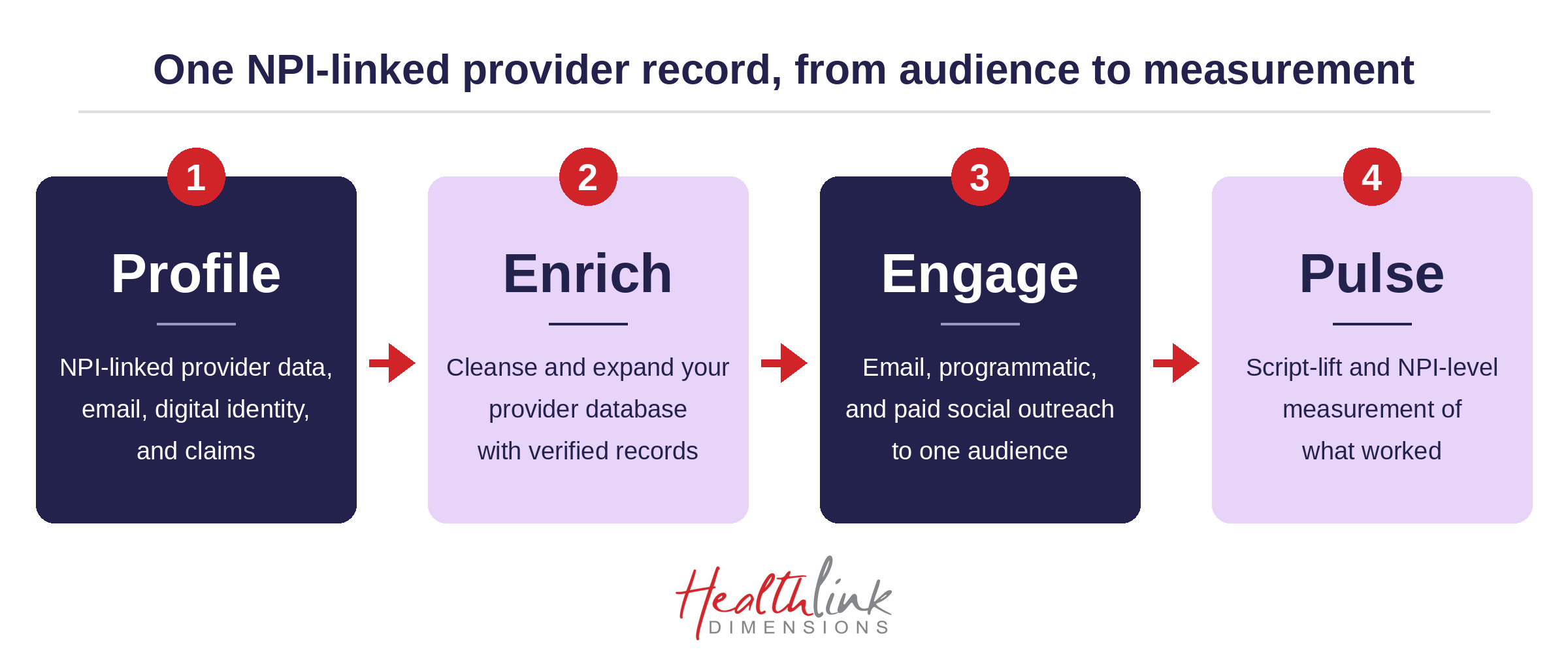 HealthLink Dimensions connects one NPI-linked provider record to cleansing, outreach, and NPI-level measurement in a single workflow.
HealthLink Dimensions data is provider-focused, contains no patient-level information, and avoids highly regulated sensitive personal information. It is tied to NPI rather than protected health information (PHI). The company holds the TrustArc TRUSTe Enterprise Privacy & Data Governance Practices Certification, a third-party review of privacy and data governance practices, and a SOC 2 Type II attestation issued by independent auditor A-LIGN, an audit of security controls. It is also a member of the Network Advertising Initiative (NAI), a self-regulatory association for digital advertising.
Superior Service is one of the company's three differentiators. Dedicated teams focus on long-term results rather than transactional support, and a 95% client retention rate and a Net Promoter Score (NPS) of 79 reflect that approach.
HealthLink Dimensions is built for U.S. provider audiences. It is not a global reference database, so multi-country programs may pair it with another source.
Which IQVIA Alternatives Fit Your HCP Segmentation and Activation Goals?
No single vendor leads every healthcare marketing objective, so the useful comparison is by audience segmentation, omnichannel activation, and measurement needs. The table summarizes each option's primary strength from public vendor descriptions. Each row names the type of team the platform is most often matched to. Confirm scope and figures with each vendor during evaluation.
Primary strengths of IQVIA OneKey and seven alternatives, from public vendor descriptions as of October 2026
|
Platform |
Primary strength |
Best matched to |
|---|---|---|
|
HealthLink Dimensions |
NPI-linked U.S. provider data with email, digital identity, claims, outreach, and measurement |
U.S. programs that want audience data and activation together |
|
IQVIA OneKey (baseline) |
Global HCP and HCO reference data across 118 countries |
Multi-country enterprises |
|
Definitive Healthcare |
Hospital, health system, and other organization profiles |
Teams selling into institutions as well as clinicians |
|
H1 |
Provider data, claims, and research insights, including KOL engagement |
Teams that combine commercial and clinical research use cases |
|
Doximity |
Professional network of U.S. clinicians used for digital advertising |
Marketers buying endemic digital reach |
|
Alpha Sophia |
Claims-based segmentation and KOL discovery |
MedTech startups and small to midsize teams |
|
AcuityMD |
MedTech sales intelligence and call planning |
MedTech sales organizations |
|
MedScout |
Claims-based territory planning |
MedTech field teams |
How to Pilot an HCP Targeting Platform in Five Steps
A short, controlled pilot shows more than a demo. Give every finalist the same audience and the same questions, then compare results side by side. The steps below fit most pharmaceutical, MedTech, health plan, and agency teams.
-
Choose one audience segment, such as a single specialty in a defined region.
-
Send the same record file to each vendor and compare match rates.
-
Ask how email addresses are verified and how often.
-
Run a small activation test with identical creative and compare delivery.
-
Check whether reporting ties to individual NPIs, then decide.
Matching the Platform to Your Audience and Market
Whichever vendor you choose, a complete workflow runs from audience definition through measurement. Profile defines the audience, Enrich keeps records accurate, Engage reaches clinicians, and Pulse shows what worked. Score each finalist against that full path and let a real pilot settle the decision.
Frequently Asked Questions
About HealthLink Dimensions
HealthLink Dimensions helps life sciences companies, hospitals, health plans, and agencies reach and engage healthcare providers with precise, privacy-safe data. Four product families (Profile, Enrich, Engage, and Pulse) cover audience definition, data hygiene, omnichannel outreach, and campaign measurement. The company is built on three differentiators: Product Excellence, Superior Service, and Privacy & Compliance. Data to Insight. One Trusted Partner.