



Pharma marketing teams use verified healthcare professional data to focus rep time, coordinate follow-up, and measure which activity changes prescribing.
Pharma marketers use healthcare professional (HCP) data to improve field sales force effectiveness in four ways: building accurate target lists, matching records across systems through the National Provider Identifier (NPI), coordinating digital outreach with rep visits, and measuring prescribing results after each campaign. Each step depends on data that is current, verified, and linked to a single provider identity.
Key Takeaways: Using HCP Data to Improve Field Sales
-
Pharma marketers use HCP data to decide which providers reps visit, which message each provider receives, and how follow-up is delivered, then measure the change in prescribing afterward.
-
An NPI is a unique 10-digit number that stays the same when a provider changes name or address, which makes it a dependable key for matching records across CRM, claims, and marketing systems.
-
The NPI carries no information about specialty or location, so accurate target lists need demographics, affiliations, and contact data from additional sources.
-
Rep visits and digital channels perform best when both draw from one NPI-linked audience, which prevents duplicate or conflicting contact.
-
Script-lift analysis compares prescribing before and after outreach, and against similar providers who were not reached, to link activity to results.
What Is HCP Data and Why Does Field Sales Need It?
HCP data is a set of records describing licensed clinicians: who they are, what they specialize in, where they practice, how they connect to health systems, and how to reach them. Field sales teams use these records to decide which providers to visit, how often to call, and which message to bring.
Field sales force effectiveness describes how well sales representatives' time and activities translate into prescribing outcomes. Representatives can only act on records that are accurate, so the quality of the underlying data sets a ceiling on that effectiveness.
At a glance: five data types field teams rely on
-
Demographics: name, specialty, credentials, and practice address.
-
Affiliations: the hospitals, groups, and networks where a provider works.
-
Contact data: verified email addresses and digital identities.
-
Prescribing activity: claims-based views of what providers prescribe.
-
Identifiers: the NPI that links every record to one provider.
The NPI is a unique 10-digit number assigned through the National Plan and Provider Enumeration System, which the Centers for Medicare & Medicaid Services (CMS) operates. According to the CMS guidance on National Provider Identifiers, an NPI stays the same when a provider changes name, address, or other details, and it carries no information about location or specialty. Providers can be looked up in the free NPI Registry. Every other attribute must come from additional sources.
How Do Pharma Marketers Build Accurate Target Lists?
Pharma marketers build target lists by starting with a complete provider universe, adding specialty and prescribing data, and ranking providers by potential value. The list is then refreshed on a recurring schedule so representatives call on providers who still practice at the listed location.
Checklist: building a target list from HCP data
-
Define the provider universe by specialty, geography, and credentials.
-
Match every record to an NPI so duplicate records collapse into one provider.
-
Add affiliations to show where each provider practices and which networks they belong to.
-
Layer in claims-based prescribing data to estimate current volume and future potential.
-
Segment providers into tiers, and assign each tier a call frequency and channel mix.
-
Refresh the list on a set schedule and remove providers who have moved, retired, or changed practices.
How Does Data Quality Change Rep Productivity?
Data quality determines how much representative time reaches a real, reachable, and relevant provider. Each outdated address, duplicate record, or missing affiliation turns a planned call into wasted effort and delays follow-up. The table below maps common problems to their field impact and prevention.
|
Data problem |
Effect on field activity |
Preventive practice |
|
Outdated practice address |
A representative visits a location where the provider no longer practices. |
Validate addresses against current directories on a regular cycle. |
|
Duplicate provider records |
Two representatives or two campaigns contact the same provider. |
Match and merge records on the NPI. |
|
Missing affiliations |
A representative misses the health system context around a prescribing decision. |
Add network and facility relationships to each provider record. |
|
Unverified email address |
Follow-up emails bounce, and the handoff from rep visit to digital outreach stalls. |
Verify email addresses on a recurring cycle. |
|
Unlinked prescribing data |
Targeting reflects prescription volume the team cannot trace to a specific provider. |
Link claims data to the provider NPI. |
Each fix in the table depends on the same foundation: one provider identity that every system shares. Teams that key their customer relationship management (CRM) records, marketing platforms, and analytics tools to the NPI can trace a single provider from the first target list to the measured outcome.
How Do Field Teams and Digital Channels Work Together?
Field teams and digital channels work together when both draw from one NPI-linked audience. Representatives handle in-person conversations, while email, programmatic advertising, and paid social reach providers between visits. Shared data prevents duplicate contact and lets marketing time its messages around rep activity.
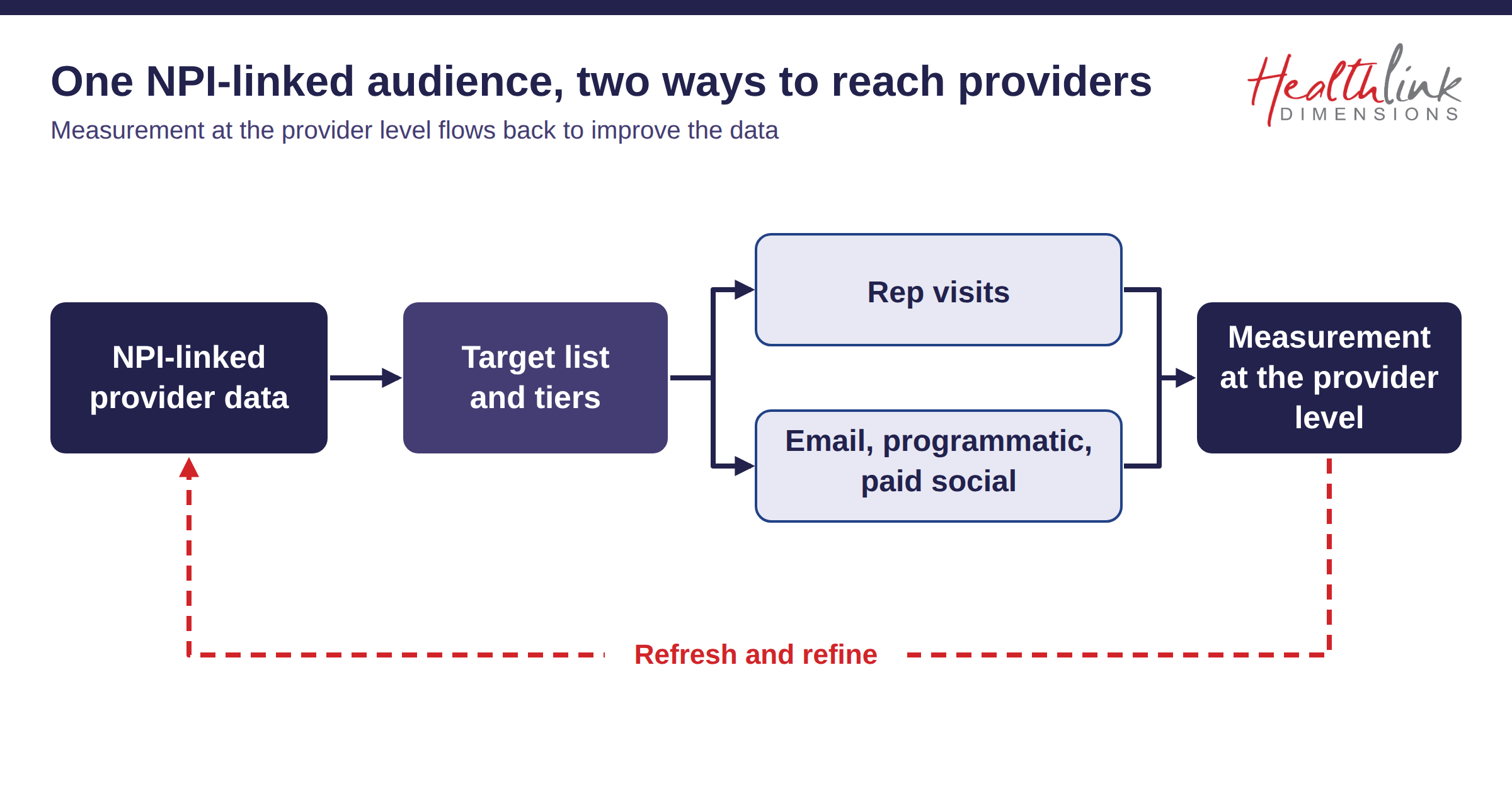
Image brief: left-to-right flowchart. Box 1 "NPI-linked provider data" leads to box 2 "Target list and tiers," which splits into two parallel boxes, "Rep visits" and "Email, programmatic, paid social," then to box 4 "Measurement at the provider level," with a return arrow to box 1 labeled "Refresh and refine." HLD brand colors, 1200x628.
At a glance: where each channel fits
-
Rep visits: in-person discussion and relationship building with high-priority providers.
-
Email: follow-up after a visit and education between visits.
-
Programmatic advertising and paid social: online reminders that reach providers between visits.
One provider identity shared by field, marketing, and analytics teams is the simplest way to keep outreach coordinated.
How Do Marketers Measure Field Sales Impact?
Marketers measure impact by comparing prescribing activity before and after outreach, and by comparing reached providers with similar providers who were not reached. This method, called script-lift analysis, links marketing and field activity to changes in prescriptions (often called scripts) at the provider level.
Four measures usually appear together in a field and marketing scorecard:
-
Reach rate: the share of the target list that was contacted.
-
Engagement: email opens and clicks, site visits, and rep call completion.
-
Channel overlap: how many providers received both a rep visit and digital outreach.
-
Script lift: the change in prescriptions among reached providers compared with a matched comparison group.
Reliable comparisons need enough providers in each group and a consistent time window. Teams should document the group sizes and the measurement period whenever they report a lift figure.
HealthLink Dimensions Perspective: NPI-Linked Data From Target List to Result
HealthLink Dimensions supports each step with four product families that share the NPI as their common key: Profile, Enrich, Engage, and Pulse. Together they cover audience definition, data hygiene, omnichannel activation (outreach coordinated across email, advertising, social, and rep activity), and measurement, so field and marketing teams work from one verified provider record.
-
Profile defines the audience with Practitioner & Facility Demographics, Healthcare Networks & Affiliations, Email Addresses, Digital Identities, and Claims Insights. The claims data covers 93% of U.S. prescriptions.
-
Enrich keeps records usable with Match & Cleanse, Enhance, and Network Directory Validation, which link records to the NPI and remove outdated listings.
-
Engage activates the audience through Email Deployment, Trigger Email, Programmatic Advertising, Paid Social, and the Clinical Briefing Report, supported by Campaign Management and Creative Services.
-
Pulse measures results with Script-Lift Analysis, Physician-Level Data (PLD), and Campaign Performance Metrics, so teams can see which activity changed prescribing.
The data behind these product families draws on 500+ sources, including 20+ government databases and 150+ directories. Email addresses are verified monthly across 3.8M+ addresses, and the Clinical Briefing Report has reached 350K+ verified HCPs.
The data is provider-focused and tied to the NPI. It contains no patient-level information, so it is not protected health information (PHI), the category of individually identifiable patient data that the Health Insurance Portability and Accountability Act (HIPAA) Privacy Rule governs. HealthLink Dimensions holds the TrustArc TRUSTe Enterprise Privacy & Data Governance Practices Certification, an independent assessment of privacy and data governance practices, and is a member of the Network Advertising Initiative (NAI), a self-regulatory organization for digital advertising.
Teams that want to apply NPI-linked data to their own field and marketing plans can contact HealthLink Dimensions.
Frequently Asked Questions
About HealthLink Dimensions
HealthLink Dimensions helps life sciences companies reach and engage healthcare providers with precise, privacy-safe data. Four product families (Profile, Enrich, Engage, and Pulse) cover audience definition, data hygiene, omnichannel outreach, and campaign measurement. HealthLink Dimensions is built on three differentiators: Product Excellence, Superior Service, and Privacy & Compliance. Data to Insight. One Trusted Partner.