




The Story of a Medical Education Leader
Picture a professional responsible for developing and promoting accredited medical education programs. Their role often spans content strategy, clinician outreach, and performance tracking, requiring close coordination with faculty, editorial teams, and accreditation leadership.
They understand that educational quality alone does not guarantee success. Programs must reach clinicians whose specialties align with the topic, whose practice patterns make the content relevant, and whose participation supports educational objectives. Yet audience development is frequently constrained by inherited email lists, publisher partnerships, and organic traffic sources that offer limited visibility and uneven accuracy.
As competition for clinician attention increases and accreditation expectations remain high, the ability to confidently define and reach the right audience becomes central to program success.
The Data Quality Challenges Medical Education Teams Face
Across CME and medical education organizations, clinician data challenges are common. Email lists age quickly. Specialty information is often broad or outdated. Distribution lists from multiple partners rarely align. Insight into who actually engaged with promotions is limited, making it difficult to assess reach beyond surface-level metrics.
These limitations create downstream consequences. Promotions may reach clinicians outside the intended specialty. Attendance numbers fluctuate unpredictably. Reporting focuses on volume rather than relevance. With limited marketing budgets, even small inefficiencies can have an outsized impact on program outcomes.
Much of the remediation work happens manually. Teams review lists, reconcile specialties, and adjust promotion plans close to launch dates. Over time, this reactive approach makes it harder to scale programs confidently or demonstrate that outreach consistently aligns with educational goals.
Why the Enrich Pillar Matters for Medical Education and Publishing
Medical education organizations perform more effectively when clinician data is actively maintained and expanded over time. HealthLink Enrich strengthens data quality so outreach decisions are based on current, reliable information.
-
Match & Cleanse compares existing circulation and outreach lists against HealthLink’s national clinician dataset to identify outdated, duplicate, or inaccurate records. This reduces list decay, improves specialty alignment, and minimizes manual cleanup before promotion.
-
Enhance fills gaps by adding new clinicians or missing attributes based on specialty, geography, or clinical relevance. This allows organizations to reach niche audiences, support emerging therapeutic areas, and ensure programs are promoted to clinicians most likely to benefit.
Together, these Enrich capabilities transform static lists into a more dynamic and dependable foundation for program promotion.
How HealthLink Enrich Supports Medical Education Outreach
Medical education teams are measured by attendance, relevance, and credibility. They must demonstrate that programs reached appropriate clinical audiences, supported learning objectives, and respected accreditation standards.
HealthLink Enrich helps teams move away from guesswork by strengthening the data behind every promotion. Outreach lists become more precise. Specialty targeting becomes easier to define and explain. Engagement data ties back to a clearer clinician profile, improving confidence in reporting.
As data quality improves, teams spend less time correcting lists and more time refining distribution strategies. Programs fill more consistently with relevant clinicians. Internal conversations shift from questioning audience composition to improving content performance and learner engagement.
Building Medical Education Programs on a Stronger Data Foundation
HealthLink Dimensions supports the full healthcare data lifecycle. Profile establishes clinician identity. Enrich improves and validates data quality over time. Engage powers outreach across email and digital channels. Pulse delivers insight into who engaged and how programs performed.
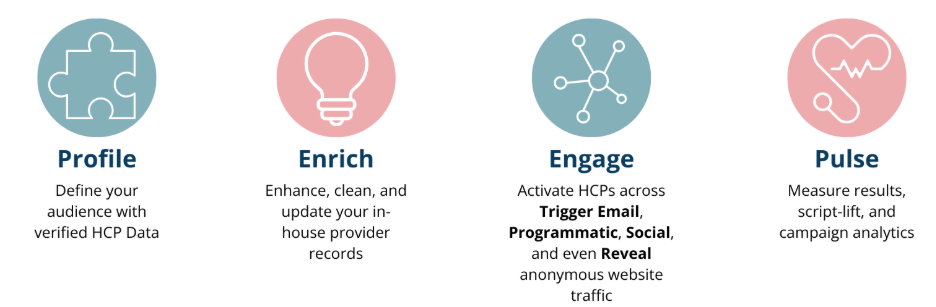
When Enrich works alongside Profile, medical education organizations gain greater control over audience quality and consistency. Outreach becomes more intentional. Reporting becomes more defensible. Programs are better positioned to meet both educational and organizational expectations.
For CME and medical education teams navigating limited resources and rising scrutiny, enriched clinician data provides the stability needed to reach the right audiences, support meaningful education, and sustain long-term program success.