




The Story of a Medical Education Leader
Picture a professional responsible for planning and promoting accredited medical education programs. Their role blends content strategy, audience development, and program performance. One day they are working with faculty to refine learning objectives. The next they are focused on ensuring an upcoming activity reaches the right clinical audience.
With years of experience in medical communications and education, they understand that relevance matters as much as reach. Filling seats is not enough. Programs must attract clinicians whose specialties align with the content and whose participation supports educational goals and accreditation requirements. Yet audience acquisition often relies on inherited email lists, publisher partnerships, or organic traffic that offers limited precision.
This leader operates in a lean environment. Budgets are tight. Teams are small. Every outreach decision carries weight. When attendance falls short or the wrong clinicians engage, the consequences show up quickly in program performance, reporting, and internal confidence.
The Audience Challenges Facing CME and Medical Education Teams
These challenges are common across the medical education and publishing landscape. Email lists vary widely in quality and age. Specialty targeting is often broad, making it difficult to reach niche clinicians. Circulation lists from different partners rarely align, and visibility into who actually engaged with promotions is limited.
As digital channels expand, expectations rise. Stakeholders want to see evidence that programs reached appropriate clinical audiences. Accreditation bodies expect relevance and rigor. Internal leaders want assurance that limited marketing dollars are being used effectively.
Without a reliable provider foundation, teams spend time troubleshooting instead of improving programs. Promotions reach clinicians outside the intended specialty. Attendance numbers fluctuate. Reporting focuses on volume rather than meaningful engagement. Even strong educational content can struggle to gain traction when outreach lacks precision.
Why the Profile Pillar Matters for Medical Education and Publishing
Medical education organizations achieve stronger outcomes when outreach is built on accurate, complete provider profiles. HealthLink Profile provides the foundation needed to move from guesswork to confidence.
Practitioner & Facility Demographics ensure outreach aligns with the right specialties, credentials, and practice settings. This helps education teams promote programs to clinicians who will find the content relevant and valuable.
Healthcare Networks & Affiliations add context around how clinicians practice and where they are connected. This supports more informed segmentation and helps tailor distribution strategies for regional or institution-specific programs.
Email Addresses are central to CME promotion. HealthLink maintains email accuracy through a rigorous verification process. Email addresses are verified monthly with one of four industry-leading deliverability vendors. Each month, we rotate between these services to double-check accuracy and keep deliverability rates high.
Digital Identities link clinicians across email and digital channels, extending reach beyond a single list and enabling consistent promotion across platforms.
Claims Insights add an additional layer of intelligence by supporting segmentation based on real-world clinical activity. This helps ensure programs are promoted to clinicians whose practice patterns align with the educational topic without relying on patient-level data.
Together, these elements create a reliable provider profile that supports precise promotion, protects budget, and strengthens confidence in program reach.
How HealthLink Supports CME and Publishing Success
Medical education teams are measured by attendance, relevance, and credibility. They must attract the right clinicians, demonstrate meaningful reach, and maintain alignment with accreditation standards, all while working within constrained budgets.
HealthLink’s Profile solutions reduce uncertainty by providing a dependable source of provider identity from the start. Instead of relying on static circulation lists or fragmented partner data, teams gain access to unified profiles that support smarter segmentation and cleaner outreach.
Email performance improves as deliverability stabilizes. Promotions reach clinicians whose specialties align with program content. Digital distribution becomes more consistent. Engagement data ties back to a clear provider profile, making reporting more defensible and more useful.
The shift is tangible. Programs fill more reliably with relevant clinicians. Reporting conversations move beyond raw counts to demonstrate thoughtful audience selection. This leader becomes known for running efficient, targeted promotions that respect both educational goals and budget realities.
Rebuilding Medical Education Outreach on Solid Ground
HealthLink Dimensions supports the full healthcare data lifecycle. Profile establishes a complete provider identity. Enrich improves data quality and fills gaps. Engage powers outreach across email and digital channels. Pulse delivers insight into who engaged and how programs performed.
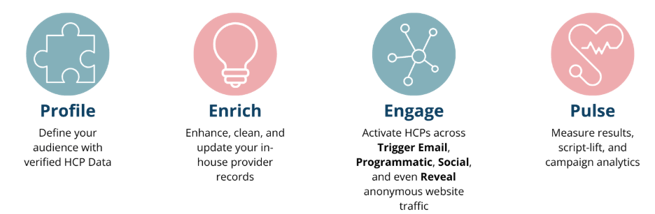
When these capabilities work together, medical education organizations gain clarity and control. Outreach becomes more targeted. Engagement becomes easier to understand. Reporting aligns more closely with accreditation and internal expectations.
For CME and medical education teams navigating increasing scrutiny and limited resources, stronger provider profiles provide the foundation needed to promote programs with confidence, reach the right clinicians, and support long-term educational impact.