



Healthcare marketers today face increasing scrutiny around how advertising audiences are built, sourced, and activated. That’s a good thing. The more transparent the ecosystem becomes, the easier it is for marketers to work with partners they trust.
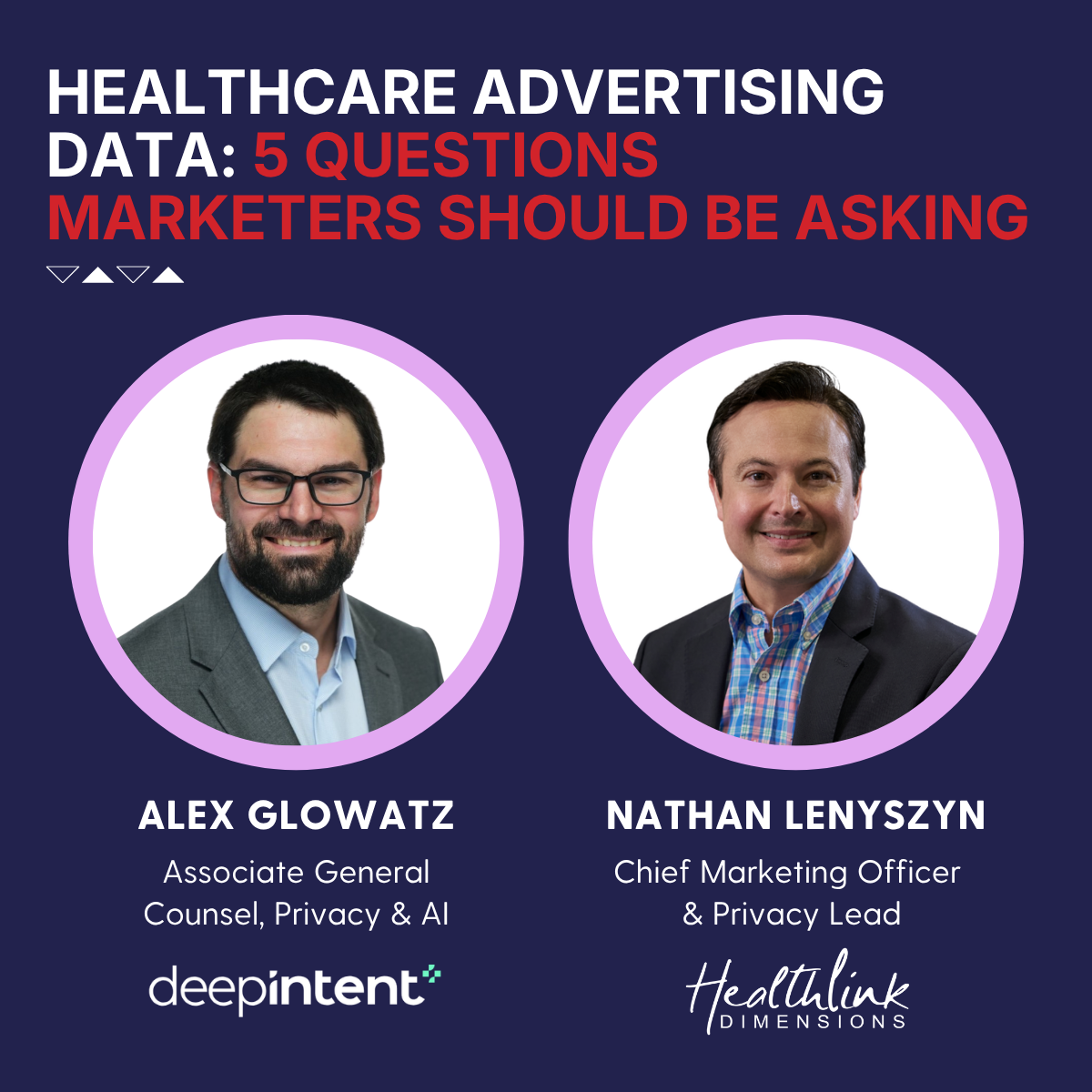
To unpack some of the most common questions advertisers ask, we spoke with Nathan Lenyszyn, Chief Marketing Officer and Privacy Lead at HealthLink Dimensions and Alex Glowatz, Associate General Counsel – Privacy and AI at DeepIntent. Both organizations are active members of the Network Advertising Initiative (NAI) and participate in ongoing working groups that monitor privacy and data security developments across the U.S. advertising industry.
Here are five questions healthcare marketers should keep in mind when evaluating healthcare advertising data.
Question 1: What do marketers often misunderstand about privacy in healthcare advertising?
Nathan: In healthcare advertising, privacy is often oversimplified as a question of opt-in consent. In reality, responsible marketing depends on a broader data governance framework grounded in transparent sourcing, appropriate data use, and giving clinicians meaningful control over how they are contacted.
In the United States, professional communication with licensed healthcare providers typically operates under the principle of legitimate business interest.
It’s also important to remember that responsible HCP marketing focuses on professional information about licensed clinicians, not sensitive personal data.
In practice, that means applying common-sense principles like data minimization. The goal is to use only the information necessary to identify and communicate with healthcare professionals in their professional capacity. Sensitive personal information is not part of the equation.
Responsible outreach focuses on sharing clinically relevant information with verified healthcare professionals while giving them clear control over their communication preferences.
DeepIntent Perspective (Alex)
Alex: One common misunderstanding in healthcare advertising is the idea that privacy compliance can be entirely handled at the company level. In reality, privacy in this space is an ecosystem challenge and requires understanding of both upstream and downstream data practices. You need to work with companies who you can trust to navigate the increasingly complex regulatory and technological ecosystem.
That’s where infrastructure providers play an important role. Platforms like DeepIntent help establish guardrails that allow marketers to activate audiences responsibly while reducing compliance risk. This includes things like validating data sources, enforcing policies around permitted data use, and ensuring that targeting and activation occur within environments designed specifically for healthcare marketing.
In fact, privacy protection can be embedded into the architecture of a marketing platform itself. Privacy compliance doesn’t have to be a roadblock. When platforms set clear expectations around sourcing, governance, and activation, it becomes easier for marketers to reach the right audiences in a privacy-safe manner.
Question 2: Where does responsible healthcare provider data actually come from?
Nathan: Responsible healthcare provider data should come from multiple transparent sources, not a single collection method.
At HealthLink Dimensions, our foundation begins with verified professional sources such as:
-
the National Provider Identifier (NPI) registry
-
state licensing boards
-
hospital and health system directories
-
accredited professional publications and directories
These sources help establish the baseline identity and credentials of licensed clinicians.
However, maintaining accurate provider data requires more than static records. Healthcare professionals frequently change affiliations, practice locations, and contact preferences.
That is why we also maintain direct engagement with healthcare providers through our owned channels. Each year we deploy more than 25 million emails to clinicians, and over 400,000 healthcare providers receive the Clinical Briefing Report newsletter each week.
These engagement signals provide ongoing validation that provider contact information remains active and relevant.
Finally, we supplement these sources through trusted partner contributions. Any external data provider must participate in our internal privacy and security assurance program before their data is integrated.
When these layers work together, the result is a continuously validated provider dataset built from professional registries, direct clinician engagement, and vetted partner sources.
DeepIntent Perspective (Alex)
Alex: From a platform perspective, responsible healthcare provider data starts with transparency around sourcing and governance. Advertisers should understand where audience data originates, how it is maintained, and what standards are applied before it ever becomes available for activation.
The FTC and state regulators have increasingly signaled that you cannot simply contract away responsibility for privacy compliance and responsible data use. That is why DeepIntent has implemented our Data HealthChecks program.
Before a data provider can enter the DeepIntent Audience Marketplace, and on an annual basis, we conduct rigorous technical and legal due diligence. We evaluate things like their data collection practices, consent and opt-out mechanisms, privacy policies, and sources of data.
We understand the risks associated with this data and only work with partners that we are confident meet our standards for privacy compliance.
Question 3: Why is ongoing verification more important than a one-time consent event?
Nathan: Healthcare data changes constantly. In fact, a recent LexisNexis Risk Solutions analysis found that 26% of prescribers experienced at least one change in their contact or license information within a 90-day period, highlighting how quickly provider data can become outdated.
Clinicians move between health systems, open new practices, update their contact information, and change professional responsibilities. A single consent event from years ago does not necessarily reflect whether a record is still accurate today.
That is why responsible healthcare datasets rely on continuous monitoring and verification.
Engagement signals from real communications, professional updates, and regular validation processes help ensure that provider records remain current and relevant. When data is stale, outreach becomes ineffective and campaign budgets are wasted.
DeepIntent Perspective (Alex)
Alex: Ongoing verification is critical because audience data doesn’t exist in isolation. It is part of a broader advertising ecosystem that depends on accuracy and responsible governance over time.
That’s why infrastructure providers need continuous visibility into how data partners maintain and refresh their datasets. This includes understanding how frequently records are updated, what validation processes are used, and whether engagement signals or professional updates are incorporated to keep provider information current.
As privacy regulations and industry expectations continue to evolve, this kind of continuous governance becomes even more important. It helps ensure that advertisers can rely on the marketplace not just at the moment of onboarding a partner, but throughout the lifecycle of a campaign and beyond.
Question 4: Why are large healthcare organizations asking more questions about governance today?
Nathan: Enterprise healthcare organizations increasingly expect their data partners to demonstrate audit-ready governance, with many running extensive privacy and data governance reviews before approving marketing vendors.
Part of the reason is the regulatory environment itself. Privacy regulations in the United States are fragmented and continually evolving, with new state-level rules and enforcement expectations emerging each year. As organizations activate healthcare marketing data, they also expose themselves to regulatory scrutiny and potential reputational risk.
That reality has raised the bar for data partners. Large pharmaceutical companies and health systems want clear answers to questions like:
-
How is the data sourced?
-
What privacy safeguards are in place?
-
How are opt-out requests honored across systems?
Independent validation helps provide an additional layer of trust. Certifications and industry memberships such as TrustArc, NAI participation, and SOC 2 Type 2 audits help demonstrate that privacy and governance practices have been independently reviewed against recognized standards.
For many healthcare organizations, strong governance not only reduces legal risk. It can also simplify procurement reviews and accelerate vendor approval processes.
DeepIntent Perspective (Alex)
Alex: In short, healthcare orgs are asking more questions about governance due to risk. DeepIntent sits at the intersection of healthcare and ad tech, two heavily regulated fields. Over the past five to ten years, the regulatory and enforcement landscape around both online privacy and healthcare data has evolved significantly. As a result, organizations across the ecosystem have become far more sophisticated in how they evaluate data practices and vendor governance.
That’s not to say that this area is too risky to operate in—rather, it’s about making sure you are taking governance seriously and working with partners that prioritize transparency and compliance.
Question 5: What questions should advertisers ask any healthcare data partner?
Nathan: A few practical questions can quickly reveal how a healthcare dataset is built and maintained.
For example:
-
Where does the provider data originate, and what primary sources support it?
-
How often is the data verified or refreshed?
-
What signals confirm that provider contact information remains active and accurate?
-
How are opt-out requests managed and synchronized across systems?
-
What governance frameworks or certifications support the organization’s data practices?
-
Has the organization undergone independent third-party privacy or security audits?
Clear, transparent answers to these questions are usually a good indicator that a data provider prioritizes accuracy, accountability, and responsible marketing practices.
DeepIntent Perspective (Alex)
Alex: Nathan’s answer is a great checklist for vetting data providers and a great place to start. In addition to those questions, we focus on areas like consents and notifications, the data source, first versus third party data, whether they exclude any regions from their data, and whether the data being provided falls into any sensitive data categories across jurisdictions.
Nowadays, every company has a public facing privacy policy, and one of the first things I do when vetting a new partner is review theirs. You can also look at their cookie banner implementation and the options they give consumers. Additionally, you can determine if they are integrated with the GPC or other universal opt-out signals.
The Bottom Line
Responsible healthcare advertising depends on transparency across the entire ecosystem. Data providers, platforms, and advertisers each play a role in ensuring outreach to healthcare professionals remains accurate, respectful, and privacy-conscious.