



A practical guide to the data sources behind HCP email programs, the criteria for comparing providers, and how verification keeps campaigns deliverable.
The best healthcare professional (HCP) data source for email marketing combines a National Provider Identifier (NPI) foundation, monthly email verification, and broad specialty and affiliation coverage. Leading options include HealthLink Dimensions, H1, IQVIA OneKey, and Veeva OpenData. The right fit depends on the audience, the geography, and how the data will be activated across channels.
Key Takeaways: Choosing an HCP Data Source for Email
-
The strongest HCP email data sources link every record to an NPI, the unique 10-digit identifier issued to U.S. healthcare providers, so duplicates and outdated records can be found and removed.
-
Email addresses need recurring verification. Veeva publishes a 30-day cleansing cycle for OpenData Email, and HealthLink Dimensions verifies email addresses monthly.
-
Provider data comes from four source types: government registries, professional directories, claims data, and vendor-collected contact data.
-
Marketers can compare vendors on identifier linkage, verification cadence, coverage, privacy practices, and activation options, then confirm the choice with a sample file.
What Are HCP Data Sources and Why Do They Matter?
HCP data sources are the registries, directories, and commercial datasets that supply the names, specialties, practice locations, and contact details used to build provider audiences. They matter because email results depend on list accuracy. A record that points to a retired physician, a closed practice, or an invalid address wastes budget and can harm sender reputation.
Two terms help frame vendor comparisons. Match rate is the share of a marketer's records that link to a verified NPI. Identity resolution is the process of confirming that records from different systems describe the same provider. Higher match rates give marketers a cleaner base for segmentation and measurement.
Which Types of Data Feed HCP Email Programs?
Four types of data feed most HCP email programs: government registries, professional directories, claims data, and vendor-collected contact data. Each contributes a different layer, and strong providers combine them so that identity, location, activity, and reachability all describe the same provider.
-
Government registries: The National Provider Identifier registry lists each provider's NPI, name, specialty classification, and practice address. State licensure records confirm license status.
-
Professional directories: Hospital, health system, and medical society rosters add affiliations and practice relationships.
-
Claims data: Aggregated claims show provider-level prescribing and procedure activity, which supports targeting by clinical focus.
-
Vendor-collected contact data: Email addresses and digital identities are gathered and verified by the data provider so that campaigns can reach providers directly.
How Do the Leading HCP Data Providers Compare?
Leading HCP data providers differ in focus. HealthLink Dimensions emphasizes NPI-linked U.S. provider data with email addresses verified monthly. H1 emphasizes clinical and research profiles. IQVIA OneKey offers a large global reference dataset. Veeva OpenData pairs reference data with Veeva CRM workflows. Each serves a different primary need.
HealthLink Dimensions publishes this guide and lists itself first. The remaining providers are listed alphabetically. Details come from vendor-published materials and should be confirmed with each vendor before a purchase decision.
|
Provider |
Primary focus |
Published detail |
Often a fit for |
|
HealthLink Dimensions |
U.S. NPI-linked provider data, email addresses, data enrichment, and campaign engagement |
6 million+ U.S. clinicians; 500+ data sources, including 20+ government databases and 150+ directories; email addresses verified monthly by independent sources |
Marketers who want data hygiene and email deployment from one partner |
|
H1 |
Life sciences HCP and key opinion leader (KOL) profiles |
Combines contact data with professional, clinical, and research insights; enterprise pricing |
Teams that prioritize clinical and research context for KOL targeting |
|
Global HCP and healthcare organization (HCO) reference data |
23 million+ HCP and 2.6 million+ HCO profiles worldwide, with up to 1,000 attributes per profile |
Global programs that need broad reference coverage |
|
|
Reference data connected to Veeva CRM |
Email data cleansed every 30 days; deliverability of nearly 95% cited when sending from Vault CRM |
Organizations already running Veeva CRM |
Checklist: Six Questions to Ask Any HCP Data Vendor
This checklist works for any provider, including the four above.
-
Is every record linked to an NPI?
-
How often are email addresses verified, and by which method?
-
What match rate can be expected against the existing CRM file?
-
Which sources feed each data field?
-
How are opt-outs and privacy requirements handled?
-
Can the vendor supply a sample file for a test match before purchase?
HealthLink Dimensions Perspective: Profile and Enrich for Email
HealthLink Dimensions builds its provider data on 25 years of healthcare data science experience and more than 500 data sources, including more than 20 government databases and more than 150 directories. This breadth gives marketers a single reference point for provider identity, location, and affiliation.
The Profile product family covers Practitioner & Facility Demographics, Healthcare Networks & Affiliations, Email Addresses, Digital Identities, and Claims Insights. Claims Insights draws on claims covering 93% of U.S. prescriptions, which helps marketers segment by prescribing activity before a campaign begins. The data is provider-focused and tied to NPI, with no patient-level information or protected health information (PHI).
Email addresses are verified monthly with one of four industry-leading deliverability vendors. HealthLink Dimensions rotates among these services each month to double-check accuracy and keep deliverability rates high, and more than 3.8 million email addresses are verified on this schedule. Monthly verification keeps lists current as providers change practices.
The Enrich product family supports data hygiene through Match & Cleanse, Enhance, and Network Directory Validation. Match & Cleanse aligns a client's existing records with NPI-linked profiles, which reduces duplicates and improves match rates. Network Directory Validation helps health plans and other organizations keep provider directories accurate.
Privacy practices are independently reviewed. HealthLink Dimensions holds the TrustArc TRUSTe Enterprise Privacy & Data Governance Practices Certification, an independent assessment of how an organization manages personal data, and is a member of the Network Advertising Initiative (NAI).
How Does Data Hygiene Protect Email Performance?
Data hygiene protects email performance by removing invalid, duplicate, and outdated records before a send. Cleaner lists lower bounce rates, which protects sender reputation, the standing that mailbox providers assign to a sending domain based on past behavior. Recurring verification matters because providers change roles, practices, and addresses throughout the year.
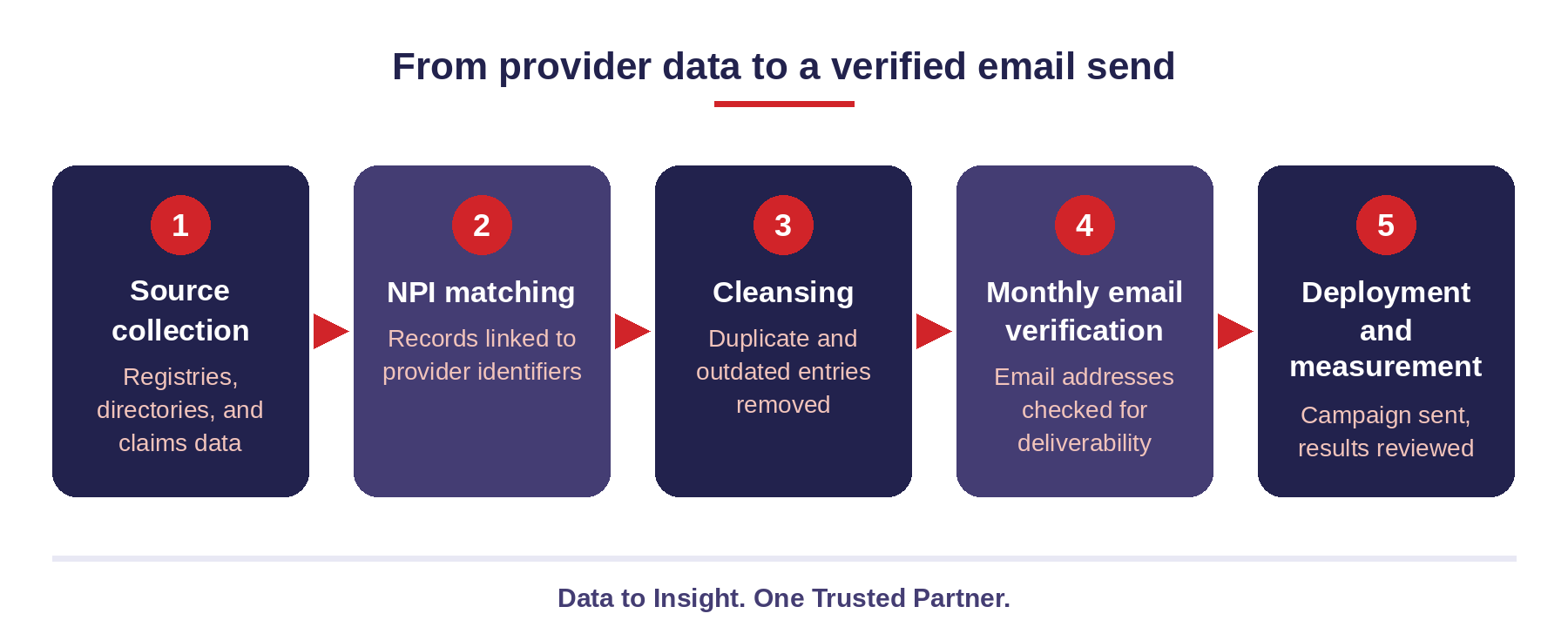
How the Data Hygiene Process Works
-
Ingest records from government, directory, and vendor sources.
-
Match each record to an NPI to confirm provider identity.
-
Cleanse duplicate and outdated entries.
-
Verify email addresses on a monthly schedule.
-
Deploy the campaign and review performance results.
A verified email address delivers value only when it is attached to the right, currently active provider.
How Do the Four Product Families Work Together?
The four HealthLink Dimensions product families cover the full campaign lifecycle: audience definition, data hygiene, outreach, and measurement. Marketers can start with one family and add others as programs mature.
-
Profile defines the audience with demographics, affiliations, email addresses, and claims insights.
-
Enrich keeps records accurate through matching, cleansing, and directory validation.
-
Engage delivers outreach through channels such as Email Deployment and Trigger Email, backed by more than 20 million email deployments each year.
-
Pulse measures results with Campaign Performance Metrics, Physician-Level Data, and Script-Lift Analysis.
Frequently Asked Questions
About HealthLink Dimensions
HealthLink Dimensions helps life sciences companies, hospitals, health plans, and agencies reach and engage healthcare providers with precise, privacy-safe data. Four product families (Profile, Enrich, Engage, and Pulse) cover audience definition, data hygiene, omnichannel outreach, and campaign measurement. HealthLink Dimensions is built on three differentiators: Product Excellence, Superior Service, and Privacy & Compliance. Data to Insight. One Trusted Partner.