




How medical device teams identify high-volume surgeons using claims data, NPI-linked profiles, and verified outreach.
Medical device companies find surgeons by procedure volume by pairing procedure-level claims data with provider profiles matched to a National Provider Identifier (NPI). Teams then rank surgeons by the number of qualifying procedures over a set period and reach the top group through verified contact channels. This guide explains each step and what to look for in a data partner.
Key Takeaways: How Device Companies Target Surgeons by Volume
-
Procedure volume is the number of times a surgeon performs a given procedure over a defined window, counted by procedure code.
-
Claims data is the main source for ranking volume at scale, and NPI matching ties each count to the correct surgeon.
-
Volume alone is not enough. Site of service, hospital affiliations, and recency change which surgeons are worth prioritizing.
-
Targeting only pays off when the surgeon list is paired with verified contact data.
-
Script-lift analysis and campaign metrics show whether outreach to high-volume surgeons changed behavior.
Why Procedure Volume Matters for Device Companies
Procedure volume matters because surgeons who perform a procedure often are the ones most likely to evaluate, adopt, and train others on a related device. Specialty and title cannot show this, because two surgeons in the same specialty can have very different caseloads.
Procedure volume is the count of times a provider performs a specific procedure in a set period. It is measured with procedure codes, such as the Current Procedural Terminology (CPT) codes maintained by the American Medical Association, which describe the services and procedures physicians perform. Campaigns built on specialty alone can miss high-value targets and spend budget on surgeons who rarely use the procedure.
What Data Sources Show Surgeon Procedure Volume?
Three main source types show surgeon procedure volume: public Medicare files, multi-payer claims data, and clinical registries. Each answers a different question, so many device teams combine them. The table compares what each one shows and where it falls short.
|
Source type |
What it shows |
Strengths |
Limits |
|
Public Medicare files, such as CMS Medicare Physician & Other Practitioners data |
Services billed to Medicare by individual provider |
Free, public, and organized by NPI |
Reflects Medicare patients only, small counts are suppressed, and data is aggregated by year |
|
Multi-payer claims data (Medicare, Medicaid, commercial) |
Procedures, surgeries, diagnoses, and prescriptions across payers |
Broader patient mix and finer filtering by procedure, volume, and therapeutic area |
Requires NPI matching and a vendor that explains its coverage |
|
Clinical registries |
Detailed outcomes and device use at participating sites |
Rich clinical context |
Limited to participating sites and specialties |
Claims data is usually the best starting point for ranking volume, because it covers many providers and payers in one consistent format.
How to Build a High-Volume Surgeon List
A high-volume surgeon list is built in five steps: define the procedure codes, set a volume threshold and time window, match results to NPIs, layer in affiliations and site of service, and validate contact data. Following the steps in order keeps the list accurate and actionable.
-
Define the procedure codes. List the CPT and diagnosis codes tied to your device. Include related codes so surgeons who perform adjacent procedures are not missed.
-
Set a threshold and window. Choose a time window, such as the past 12 months, and a minimum volume. Decile ranking (sorting surgeons into ten equal groups by volume) helps you focus on the top groups.
-
Match every result to an NPI. The National Provider Identifier is a unique 10-digit number for each U.S. healthcare provider. Confirm identities against the NPPES NPI Registry so two surgeons with similar names are not merged.
-
Layer in affiliations and site of service. Add the hospitals and practices where each surgeon operates. A surgeon's volume at a facility you can reach matters more than raw volume elsewhere.
-
Validate contact data. Confirm current emails, practice locations, and affiliations before outreach begins.
Common Pitfalls When Ranking Surgeons by Volume
The most common ranking errors come from data quality, not from the volume math. Four issues cause most of the misses, and each one is avoidable with the right checks.
-
Duplicate or mismatched NPIs. Split records can understate one surgeon's volume and overstate another's.
-
Volume split across facilities. A surgeon operating at three hospitals may look average at each one but rank high overall.
-
Outdated affiliations. A surgeon who changed health systems can send your outreach to the wrong place.
-
Thin sample sizes. A short time window can promote surgeons who had one busy quarter.
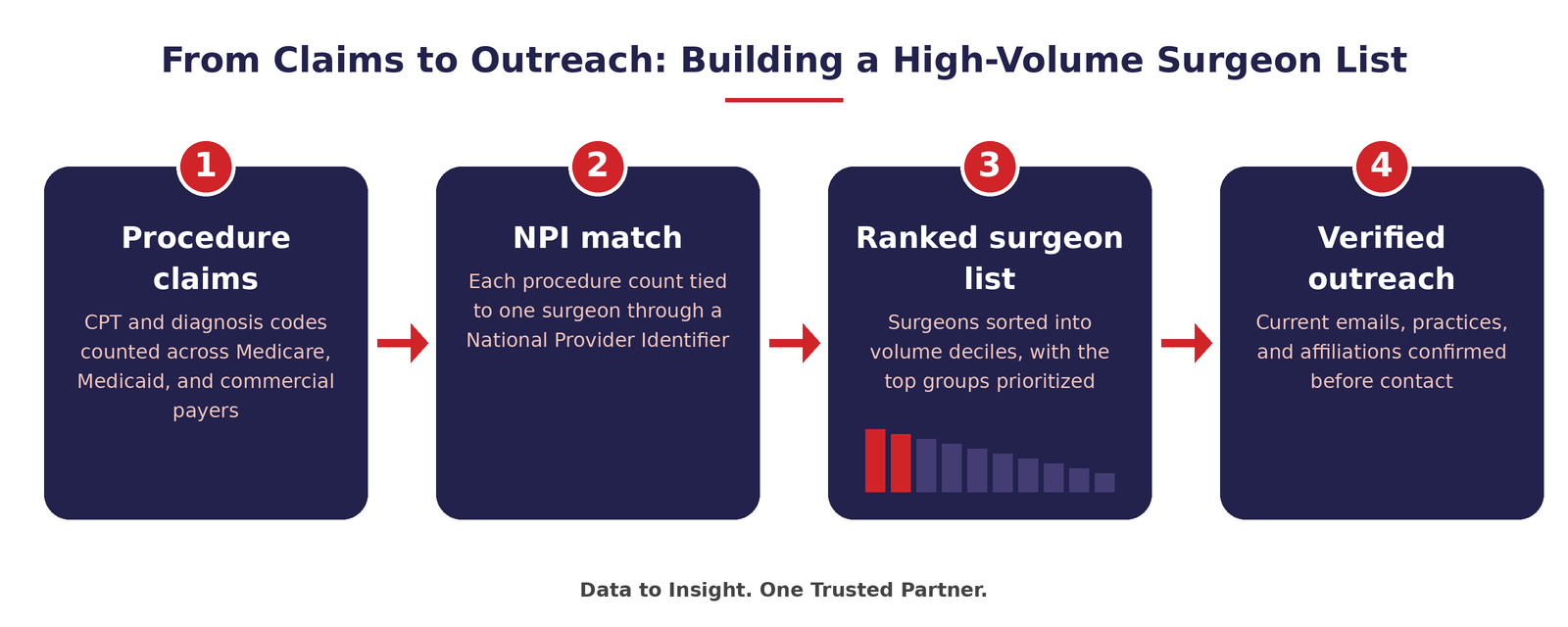
Figure: A reliable surgeon list moves from procedure claims to an NPI match, then a volume ranking, and finally verified outreach.
Volume identifies who performs a procedure often. Affiliation and contact accuracy decide whether you can reach them.
What Should You Look for in a Surgeon Data Partner?
A surgeon data partner should be able to show procedure-level coverage, accurate NPI matching, a clear refresh schedule, verified contact data, and documented privacy practices. Use these five questions to compare any vendor.
-
Does the data include procedures and surgeries, not only prescriptions? Ask which payers and code types are covered.
-
How are records matched to NPIs? Ask how duplicates are resolved and how often matches are reviewed.
-
How current is the data? Claims carry a reporting lag, so ask for the refresh schedule and request turnaround time.
-
How are contact details verified? Ask how often emails are checked and by whom.
-
What privacy practices are documented? Provider-level data tied to an NPI should not include patient-level information. Look for independent certifications. For background on federal privacy rules, see the HHS Health Information Privacy overview.
From Surgeon List to Measurable Campaign
A surgeon list becomes a measurable campaign when it moves through four stages in order: Profile, Enrich, Engage, and Pulse. Each stage has a specific job, and skipping one usually weakens the next.
-
Profile: Define the audience by procedure behavior with Claims Insights, so targeting reflects what surgeons actually do.
-
Enrich: Keep the list accurate with Match & Cleanse and Network Directory Validation.
-
Engage: Reach surgeons through Email Deployment, Programmatic Advertising, and the Clinical Briefing Report.
-
Pulse: Measure results with Script-Lift Analysis and Campaign Performance Metrics.
HealthLink Dimensions Perspective
This section describes how HealthLink Dimensions supports the workflow above, and it reflects our own product. HealthLink Dimensions Claims Insights is a Profile solution, powered in part by DocNexus, that provides prescription (Rx), diagnosis (Dx), surgery (Sx), and procedure (Px) data. The data is sourced from Medicare, Medicaid, and commercial claims covering 93% of prescriptions dispensed in the U.S.
For device teams, Surgical & Procedural Insights shows provider-level trends in intervention, treatment type, and procedure volume. High-Decile Targeting focuses on top-volume providers across selected therapeutic categories. Through the DocNexus partnership, customers can receive claims-driven trend data as soon as the same day as the request. The DocNexus platform includes more than 150 billion claims and 12 million healthcare professionals.
Results connect to Pulse, where script-lift tracking and claims-based reporting link campaign activity to outcomes. Learn more about HealthLink Dimensions Claims Insights.
Frequently Asked Questions
About HealthLink Dimensions
HealthLink Dimensions helps life sciences companies reach and engage healthcare providers with precise, privacy-safe data. Its four product families (Profile, Enrich, Engage, and Pulse) cover audience definition, data accuracy, omnichannel outreach, and campaign measurement. Data covers nearly all U.S. physicians, and email addresses are verified monthly using independent validations. HealthLink Dimensions is built on three differentiators: Product Excellence, Superior Service, and Privacy & Compliance.