

AI Provider Address Research
Can AI Find Accurate Provider Addresses? We Tested a Top Model
Artificial intelligence has earned its moment. Today's agentic models can draft contracts, write code, and research complex questions in seconds. So it is fair to ask the question we hear more and more often from healthcare marketers, data teams, and operations leaders: if AI can do all of that, can it just go find accurate healthcare provider data on its own?
AI-Powered Primary Address Identification
We decided to test the assumption directly. We gave Anthropic's Claude, one of the most capable out-of-the-box AI models available, a task that sounds almost trivial: find a provider's current practice address from the open web. The setup was deliberately lightweight, the kind of "ask the AI to figure it out" approach many organizations are now experimenting with, with no specialized data infrastructure behind it. We did give the model sensible direction, instructing it to prioritize the official webpages of medical practices, hospitals, and health systems, but we did not wall off the rest of the internet, giving the model freedom to visit whatever pages it judged valuable.

Often Wrong, and Confident Either Way
Across the cases we reviewed, Claude frequently returned an address that was wrong, incomplete, or impossible to verify. That alone would be disqualifying for most real-world uses. But the more revealing problem was its confidence.
When the AI could not find a clear answer, it rarely said so plainly. Sometimes it did flag that it was leaning on a weaker, less authoritative source. But other times it did something worse: it attributed that address to the most authoritative source it could name, an official hospital or practice page, even when the address never actually appeared there. The result looked authoritative, was formatted cleanly, and read as fact, with no flashing warning and no "I am not sure." For a human reviewer skimming the output, a confident wrong answer wrapped in a credible-looking citation is far more dangerous than an obvious blank, because nothing signals that it needs a second look.
How a Smart Model Goes Wrong
Invented citations
In a number of cases it reported an address and credited it to an official page that, on inspection, never listed that address at all. The information was not buried or misread; it simply did not exist on the source the model cited. The answer arrives with a credible-looking citation attached, and that citation is the very thing a reviewer is most likely to trust.

A real page, years out of date.
Stale sources
There were also some cases where the address it returned came from pages that were badly out of date, including news articles more than five years old, long after the provider had moved on. The information had once been accurate, which only made the wrong answer more convincing.

A real page, years out of date.
Secondhand sources
Even though we told it to prioritize official sources, the moment an official page did not give up an answer easily, the model fell back to a third-party aggregator listing. In many cases the official source did have the address; it simply took a few hops of reasoning across different parts of the website to reach it, and the model settled for the easier secondhand answer instead.

The official answer was often there, just a few hops away.
The unreadable modern web
Many of the provider and health-system pages the model tried to read are built so their content only appears when loaded in a live browser. The AI’s underlying retrieval saw a blank shell and moved on, never seeing the real address that a human visitor would see.

The model had full access to the right information but drew the wrong conclusion.
And It Does Not Scale
Set accuracy aside for a moment, and a second problem appears. Pointing a capable AI model at a single provider is not one quick lookup; it can take many searches, page loads, and retries before the model commits to an answer. That is fine for a demo but punishing in bulk. Processing just a couple hundred providers this way quickly ran into the usage limits of the consumer Claude app, and running the same work through the API at production volume gets expensive in a hurry. We used Claude Sonnet for our experiment; the estimates below also project the cost of the same workload on Claude Opus.

And it is not a one-time bill. It is a recurring one, which is where this starts to matter.
By the numbers: 100 datapoints, classified
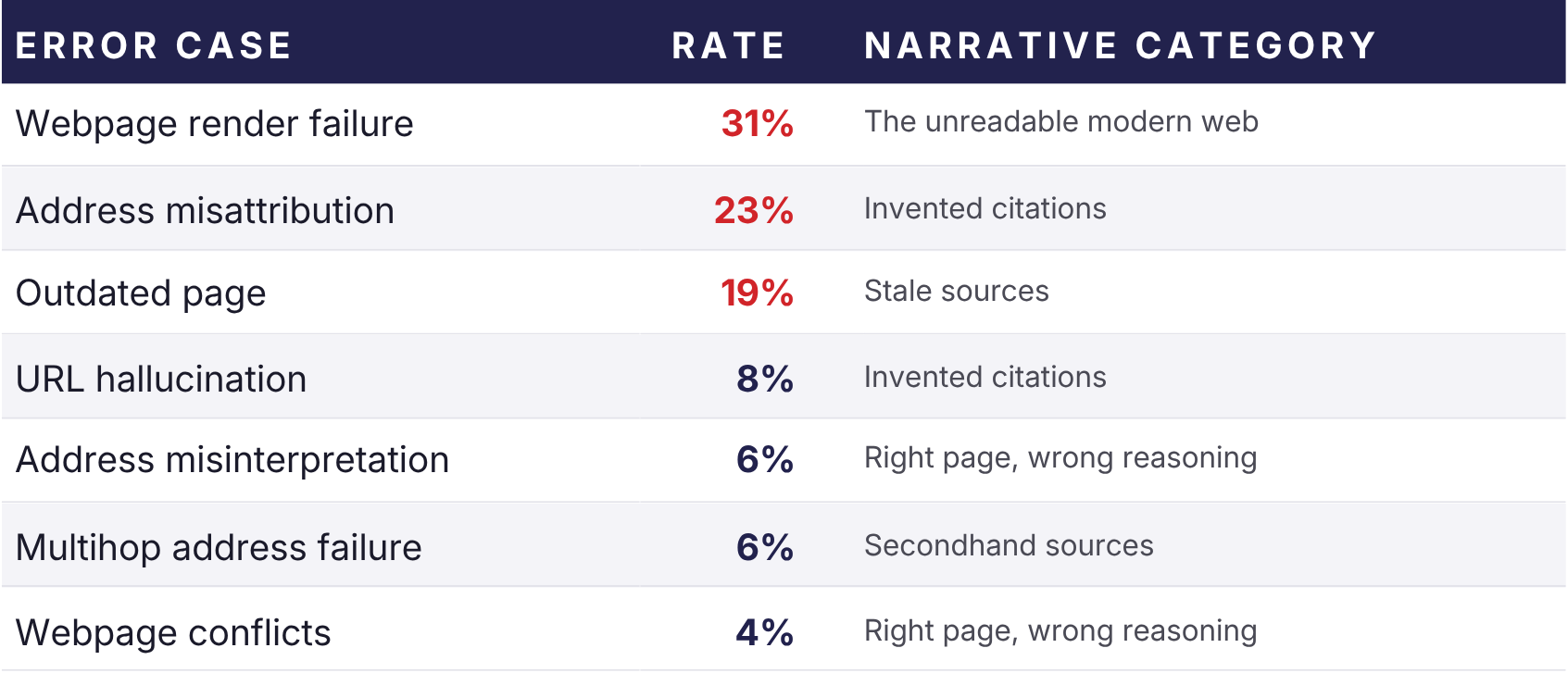
To put a size on each of those failure modes, we reviewed 100 of the resulting datapoints and classified every failure we found. One important note on reading these numbers: the error cases are not mutually exclusive. A single provider datapoint often failed in several ways at once, so each case is measured independently against the full set of 100 and the figures are not expected to sum to 100 percent.

Why This Matters Beyond the Experiment
Healthcare provider data is not static. Clinicians relocate, change affiliations, join and leave practices, and update credentials constantly. A snapshot taken today is decaying tomorrow, which means the work is never really finished: staying current means re-checking the whole population on a regular cadence.
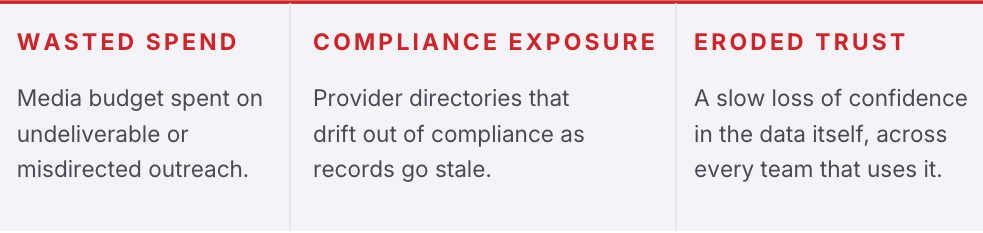
That is where the two problems collide. An approach that is both error-prone and constrained by cost and usage limits does not just stumble once; it stumbles every cycle, across every provider, and the expense and the risk compound with each refresh. Layered on top of that natural decay, the downside grows quickly: wasted media spend on undeliverable or misdirected outreach, provider directories that fall out of compliance, and a slow erosion of trust in the data itself.

The point is not that AI has no place in this work. It is a remarkable tool, and it will keep getting better. The lesson is that out-of-the-box AI, on its own and without rigorous verification behind it, is not a substitute for trusted provider data. It is a fast way to generate plausible answers, and plausible is not the same as correct.
Verified, Not Guessed: the HealthLink Difference
This is precisely the problem HealthLink Dimensions exists to solve, and it is why our approach has held up as the market's standard for accuracy.
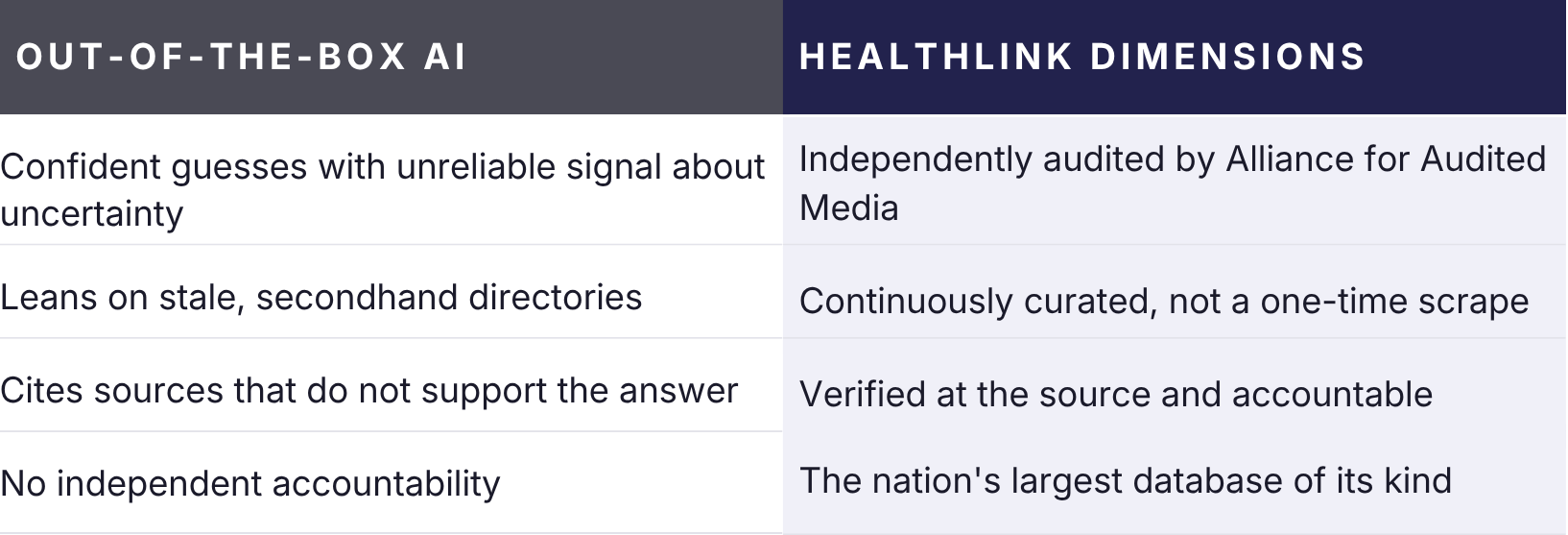
We maintain the largest database of provider and healthcare facility information of its kind in the nation, and our data quality is audited by an independent third-party verifier, Alliance for Audited Media (formerly BPA Worldwide). That distinction matters. Our accuracy is not a claim we make about ourselves; it is validated by someone outside our walls. Where out-of-the-box AI offers a confident guess, we deliver provider data that is verified, continuously curated, and accountable.
The numbers reflect it: more than 1.2 million MDs and DOs, over 600,000 NPs and PAs, 3.4 million-plus clinicians with validated email addresses, 98%-plus email coverage across MDs, DOs, NPs, and PAs, and a 95% client retention rate that tells you our customers keep trusting the data after they put it to work.

We are not standing still, either. The challenges this experiment surfaced are exactly the ones our team is focused on, combining the speed of AI with the verification rigor that has always set us apart. We are actively building reliable AI-assisted systems to support our products and services, using findings like these to guide where AI can add real value. The goal is simple: use everything AI does well without ever inheriting the confident errors it cannot catch on its own.
Speed without accuracy is not an advantage. It is a liability that scales. The future we are building combines AI with verification, using each where it adds the most value.
Verified provider data supports the full lifecycle of healthcare professional (HCP) engagement.
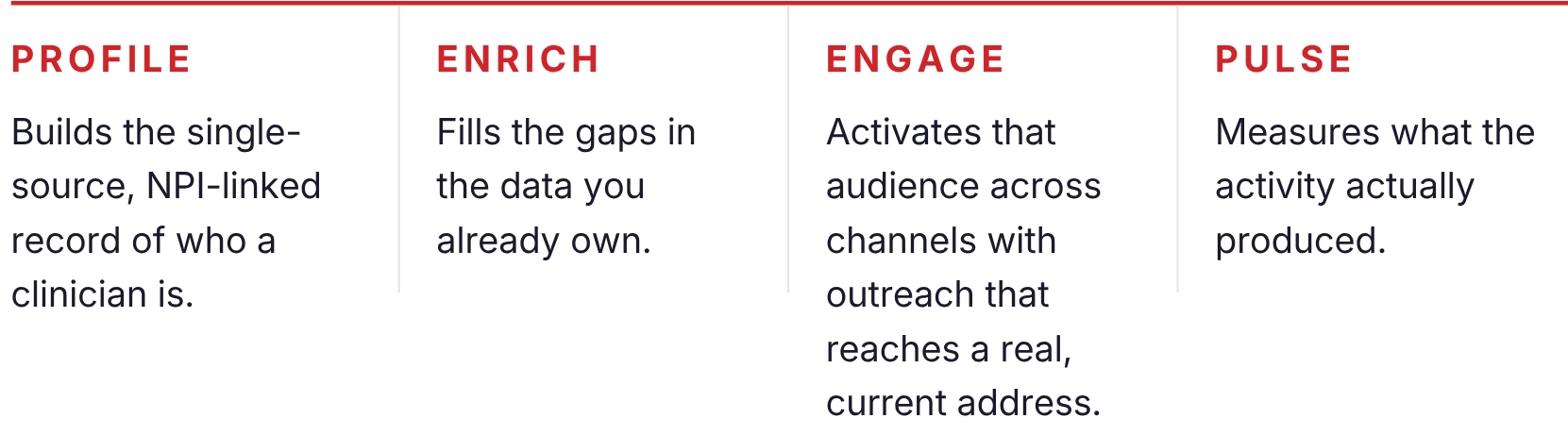
Ready to build on provider data you can stand behind? Explore our solutions across Profile, Enrich, Engage, and Pulse, or talk to a HealthLink Dimensions representative about replacing guesswork with verified, audited provider intelligence.


About HealthLink Dimensions
HealthLink Dimensions helps healthcare marketers, data teams, and operations leaders connect with the right providers using accurate, continuously maintained healthcare data. Our solutions support precise targeting, stronger outreach, cleaner directories, and more reliable provider information. We maintain one of the nation’s most comprehensive healthcare provider and facility databases, independently audited by BPA Worldwide. Everything we do is built on three commitments: Product Excellence, Superior Service, and Privacy & Compliance.
Data to Insight. One Trusted Partner.
Methodology
Source of the provider records
The providers used for this analysis came from a prospective client that was evaluating HealthLink Dimensions' address data. The client had lost confidence in the practice addresses sitting in its own provider file and sent over a test sample of HCP NPIs, names, and medical titles, asking HealthLink to return a current physical practice address for each one. The AI was therefore evaluated against a tough, real-world stress test, rather than a representative sample of the broader provider population.
The AI setup
The AI was a Claude Sonnet project running in Cowork, configured to replicate realistic usage of Claude by an end-user. Its input was a CSV listing each provider’s NPI, name, and medical title; its only research instruments were Claude’s built-in web search and web fetch tools.
For each provider, the AI searched the web by full name and medical title, then weighed what it found against a source-quality hierarchy defined in the prompt: official employer websites (hospitals, health systems, clinics, academic institutions) rank highest, while third-party aggregators such as Healthgrades or WebMD rank lowest. It recorded an evaluation of every page it relied on (the URL, the source type, the address found there, and whether that page supports or conflicts with its conclusion) and wrote the result to a structured JSON file per provider: the primary practice address, employer organization, and the best supporting URL.
How the human review happened
For human review, we pulled a sample of 100 providers where the AI and HealthLink Profile address data disagreed. To establish ground truth, the reviewer worked each record by hand. Each began with a Google search on the provider's name and medical title, from which the reviewer worked toward the most authoritative source available, usually the site of the hospital, health system, or practice that employs the provider, then searched it for any evidence of the provider's current address across profile pages, the organization's location pages, and related pages on the same site.
The reviewer recorded the best profile page found for the provider along with every address that page yielded, then judged the AI-found address against that evidence to determine the correctness. These manual verifications form the ground truth behind the main results reported in this analysis.
What this evaluation measures
This analysis was designed to answer a specific question: when out-of-the-box AI is pointed at provider address research, how does it go wrong? That is a question about failure modes and the evaluation was built to catalogue them. To characterize failures you have to study cases where failures occur, so the reviewed records were selected to concentrate them: a prospective client's test file, submitted because the client doubted its own data, narrowed to the records where the AI and the HealthLink Profile data disagreed. Cases where the two agreed were intentionally excluded.
The result is a sample deliberately enriched for difficulty in order to explore the landscape of failure modes. Consequently, the percentages in this report represent the relative frequency of specific errors within hard cases, not an overall estimate of how often AI gets a provider address wrong. Establishing a general accuracy rate would require a separate study based on a randomized, population-level sample, which we did not do here.
Frequently Asked Questions
Can AI find accurate healthcare provider addresses on its own?
Not reliably. In our review of 100 provider datapoints, a leading out-of-the-box AI model returned addresses that were wrong, incomplete, or unverifiable across every category we measured. The model also rarely signaled its own uncertainty, which makes the errors harder to catch than an outright blank answer would be.
Why couldn't the AI read provider websites it found?
Its underlying retrieval reads only the raw HTML a server sends and does not run JavaScript. Many healthcare and health-system sites assemble their page content in the browser after load, so the model received an empty shell. This accounted for 31% of the failures we reviewed, the single largest category.
What is address misattribution in AI-generated provider data?
Unlike a pure hallucination where the AI invents data entirely, address misattribution involves grabbing a real address from a low-tier source and miscrediting it to an official source. It appeared in 23% of the datapoints we reviewed. It is particularly dangerous because the citation looks credible, and the citation is the element a human reviewer is most likely to trust without checking.
Why won't better AI tooling solve this problem?
Better retrieval and rendering would address a meaningful share of these failures, but not all. In 6% of cases the model reached the correct page yet selected a secondary address over the marked primary; in 4% it ignored a genuine conflict between sources. In both patterns the model had full access to the right information and still drew the wrong conclusion, with no signal in the output that anything went wrong. Fixes for rendering are engineering work; fixes for judgment are more challenging, requiring better models, better reasoning strategies, or more complex verification layers.
How quickly does healthcare provider data go out of date?
Continuously. Clinicians relocate, change affiliations, join and leave practices, and update credentials on no fixed schedule, so any snapshot begins decaying immediately. This is why provider data requires re-verification on a recurring cadence rather than a single collection effort, and why per-cycle cost and error rates compound over time.
Does this mean AI has no role in provider data management?
No. AI is a capable tool for accelerating work that a verification process can then confirm. The distinction is between using AI as a source of truth, which our findings do not support, and using it inside a system with verification and independent accountability behind it. That second approach is what we are actively building.
Full Suite of Pillars and Solutions
Explore all HealthLink Dimensions solutions across the Profile, Enrich, Engage, and Pulse pillars to see how we help healthcare marketers build smarter campaigns.
Ready to Target Smarter & Prove Impact?
Explore how we can help your brand reach high-value prescribers and deliver measurable results.